

Within the ASI-funded AFORISMA project, the Remote Sensing Laboratory developed advanced methods for analysing PRISMA hyperspectral imagery for forest inventory and post-disturbance monitoring.
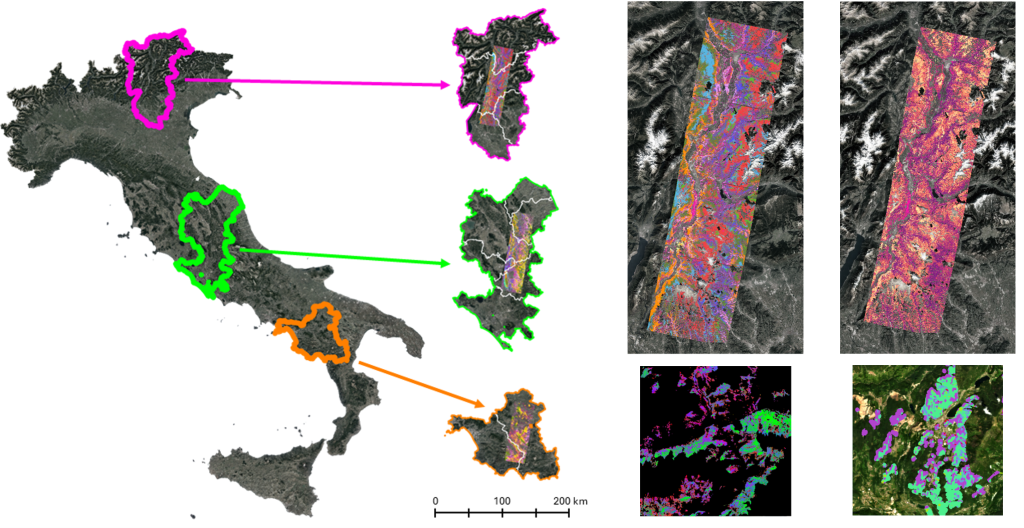
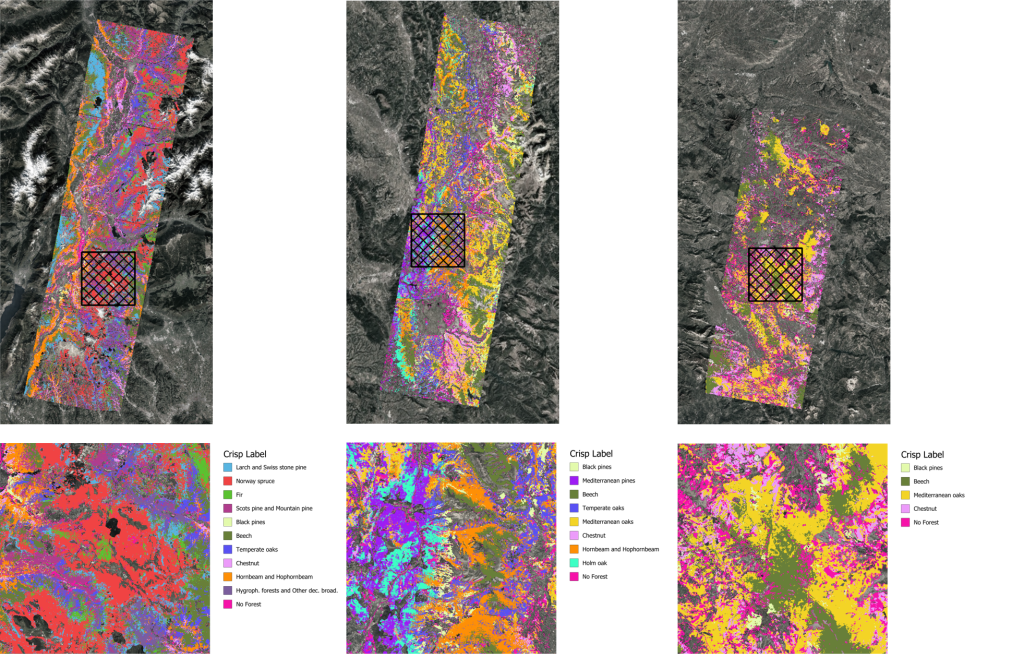
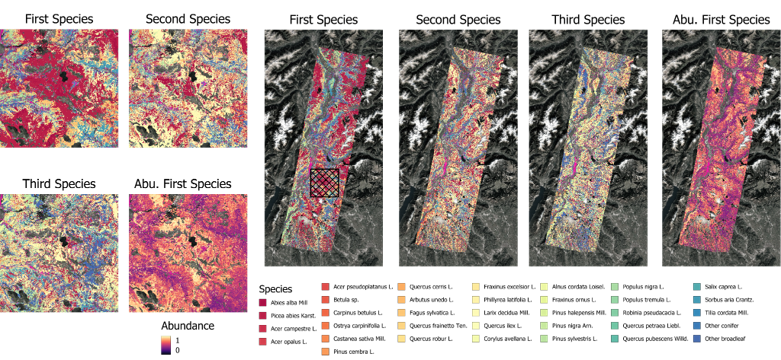
The work covered the complete processing chain, beginning with the correction and alignment of PRISMA imagery with orthophotos and field observations. On this basis, the group developed a multi-branch deep-learning architecture that combines hyperspectral signatures, panchromatic spatial information and terrain data. The method jointly performs forest-type classification and tree species classification, making it possible to identify both the forest category and the dominant tree species within each pixel. It was applied to study areas in the central-eastern Alps and the central and southern Apennines, producing detailed forest-type and tree-species maps with consistently high classification performance.
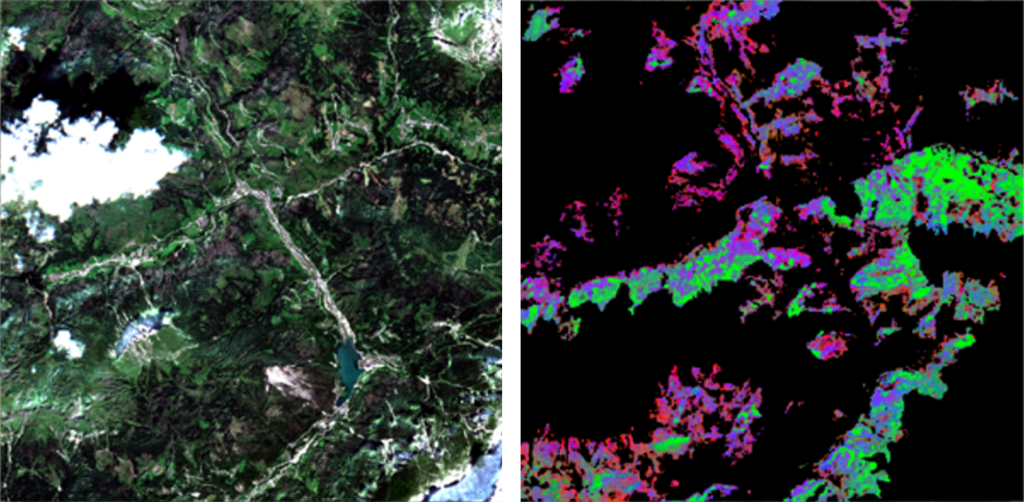
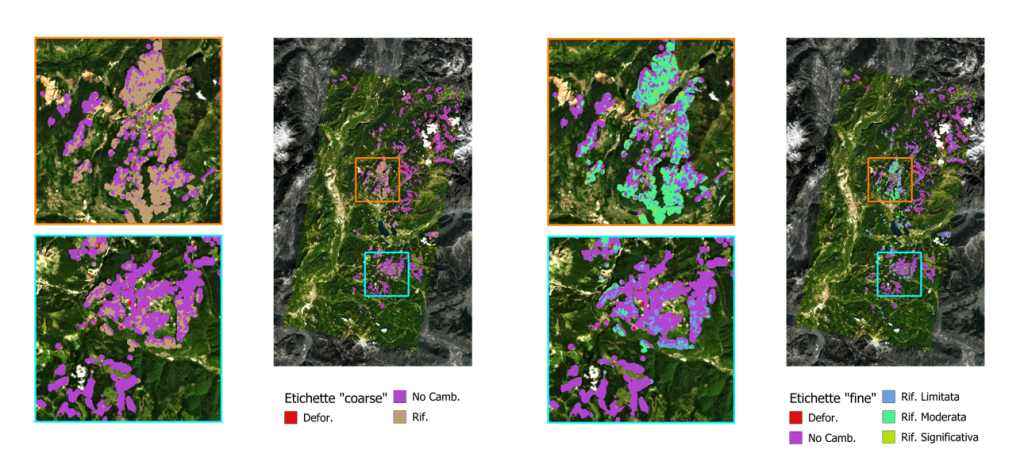
A further research line addressed the monitoring of forests affected by Storm Vaia. A hierarchical change-detection model was designed to compare multitemporal PRISMA observations and distinguish areas without significant change from deforestation and vegetation recolonisation. The approach also investigated different levels of regrowth intensity, demonstrating the potential of hyperspectral imagery for monitoring the recovery of windthrown forests, while highlighting the challenges created by short observation periods and limited reference samples.
Finally, a semi-supervised method combining contrastive learning and regression models was developed to map the abundance of healthy, affected and dead trees in areas damaged by bark beetles. Overall, the project demonstrated how PRISMA data and advanced machine-learning techniques can support large-area forest inventories, tree-species mapping and the monitoring of forest recovery and health after extreme events.