

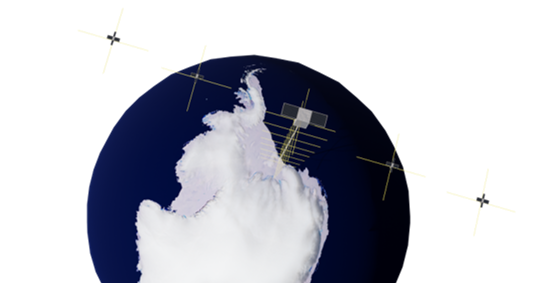
 The DistSound project (Analysis of Distributed Radar Sounder Concepts for Earth Observation at VHF Band), funded by ESA, focuses on defining and evaluating advanced spaceborne radar sounder concepts for subsurface Earth observation. Central to this initiative is the Distributed Radar Sounder (DRS) concept, which synthesizes a large effective antenna aperture by deploying a coordinated formation of small satellite sensors to significantly mitigate surface clutter and enhance resolution and signal-to-noise ratio over traditional single-platform radar sounders. A central activity of the project is the development of a concept-agnostic DRS Performance Tool and a DRS Simulator. The Performance Tool evaluates key Level-1 metrics, including penetration depth, spatial resolutions, signal-to-clutter ratio, and geolocation accuracy. Complementing this, the DRS Simulator incorporates complex 3D surface and subsurface target models, ionospheric distortions, and advanced clutter and ionospheric mitigation processing chains to simulate realistic acquisition scenarios. Together, these tools enable the systematic derivation, trade-off analysis, and engineering specification of optimal DRS mission concepts for future spaceborne Earth observation.
The project is led by the Remote Sensing Laboratory (RSLab) at the Department of Information Engineering and Computer Science of the University of Trento (UniTN) as the prime contractor. The international consortium unites prominent academic and industrial partners across Europe, including the Microwaves and Radar Institute of the German Aerospace Center (DLR), Thales Alenia Space Italy (TAS-I), the Technical University of Denmark (DTU), and EOSOL Engineering Consulting SL. This team combines complementary expertise spanning radar sounder science, space mission and platform design, ionospheric mitigation algorithms, deployable VHF antenna design, and airborne radar field measurement.